



How We Calculate Casino Similarity
When you browse a casino on Casinos Analyzer, we show you a list of similar casinos — brands that match on the things that actually matter to players. This page explains exactly how that matching works and what each result level means.
Finding a good alternative to your favourite casino used to mean scrolling through hundreds of listings and hoping something clicked. Our similarity engine does that comparison automatically — checking each casino against up to 24 different data points and returning the closest matches, ranked by how alike they really are.
What is a similarity score?
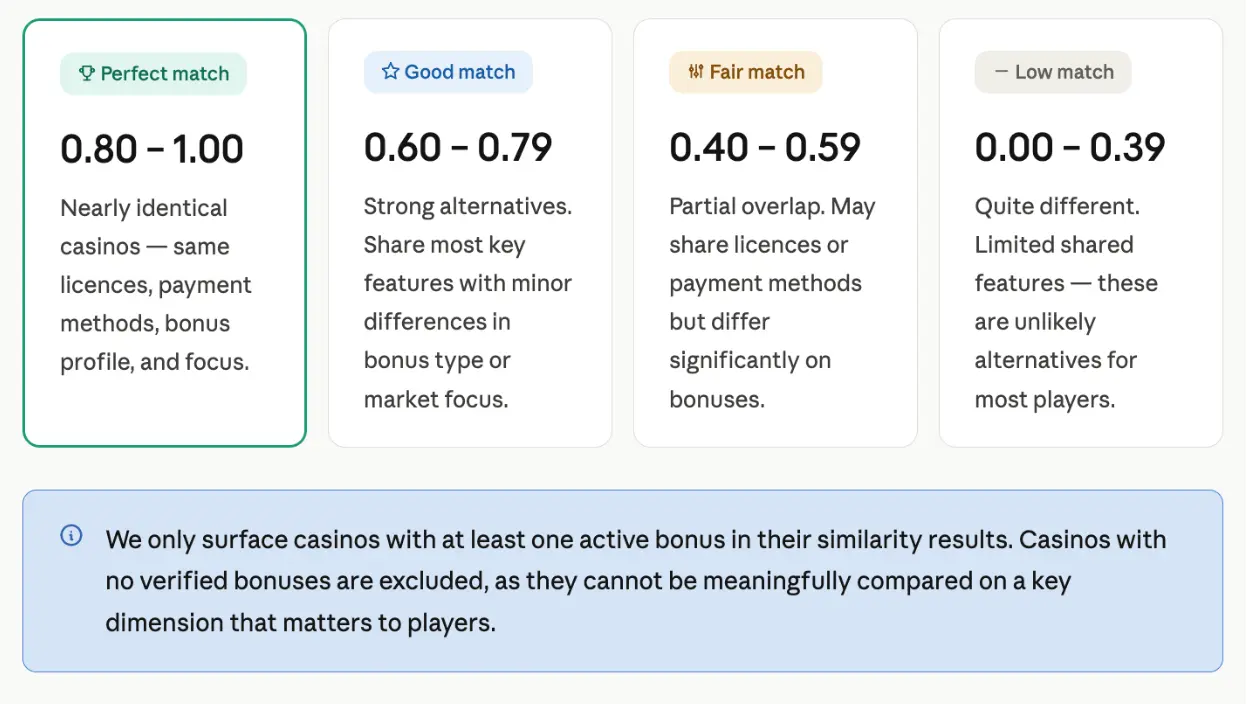
Every casino in our database gets compared to every other casino across a set of carefully weighted criteria. The result is a score between 0 and 1 — where 1 means a perfect match on every single point, and 0 means the two casinos have almost nothing in common.
In practice, scores above 0.7 are strong matches. Most useful alternatives land between 0.6 and 0.8.
What we compare — the 24 criteria
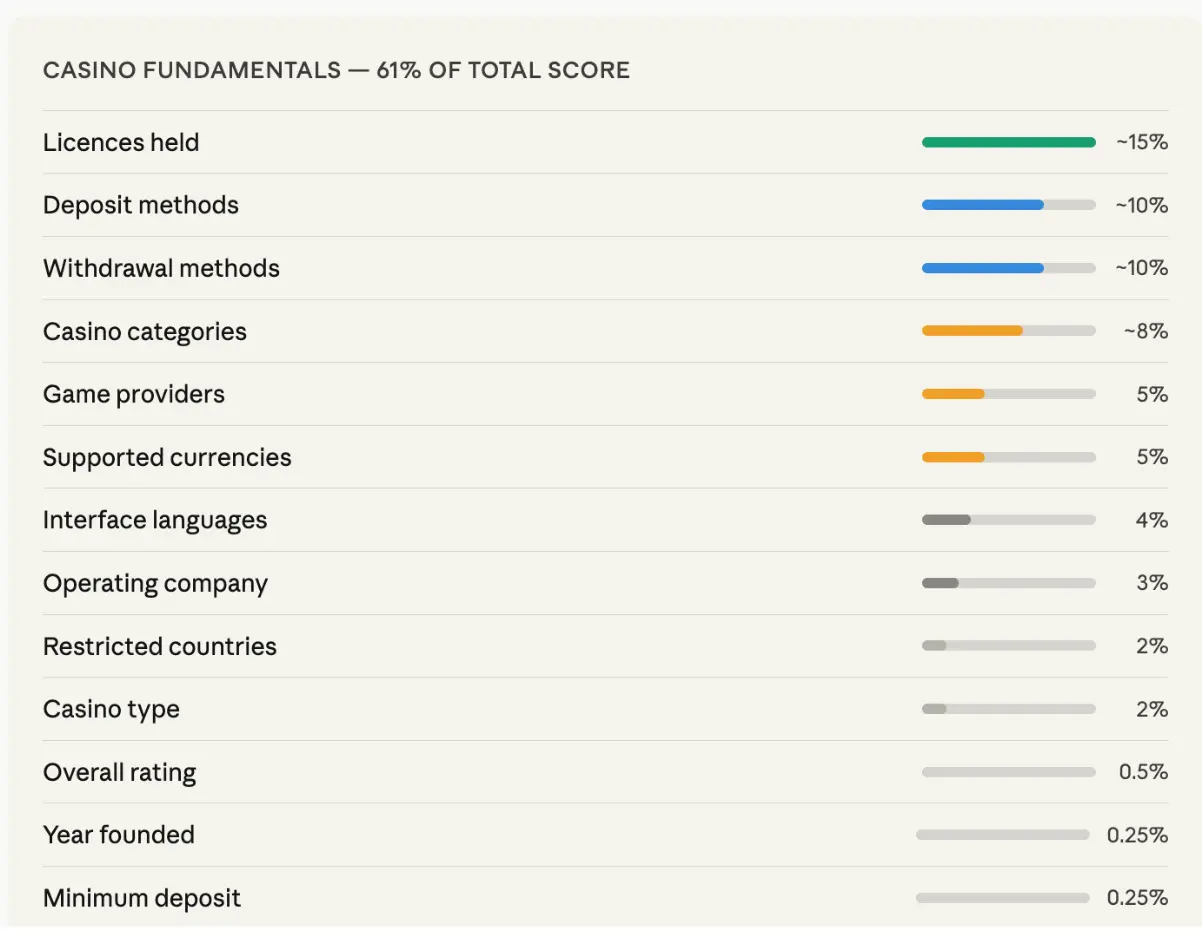
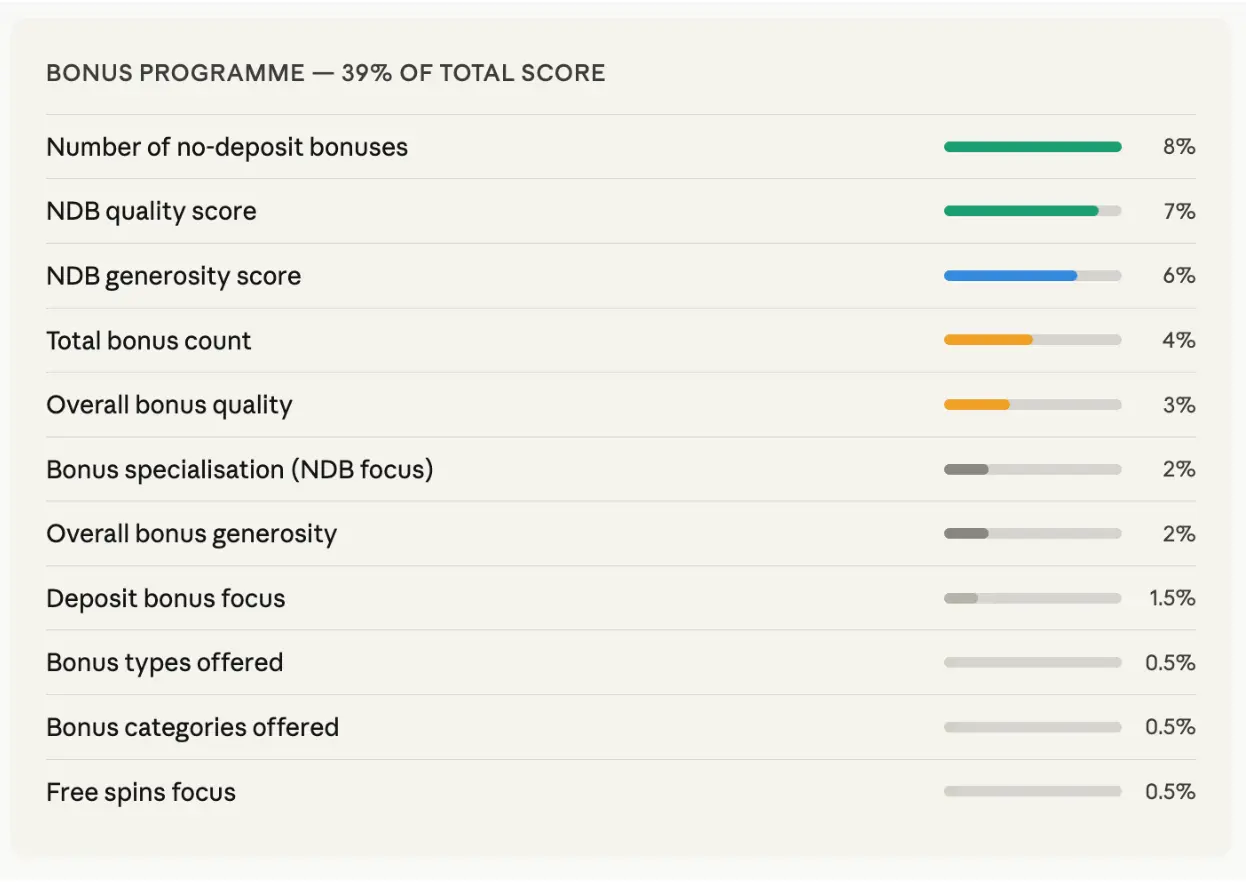
Each casino is compared on 24 criteria across two major areas: how the casino itself is set up, and what its bonus programme looks like. The two areas are weighted differently because our data shows that licences and payment methods are the strongest predictors of whether two casinos will feel similar to a player, while bonuses drive conversion and daily experience.

Bonus specialisation — what it is and why it matters
Beyond counting bonuses, we look at what type of bonus programme each casino runs. A casino with 30 no-deposit bonuses is a very different experience from one with 30 deposit-match bonuses — even if their overall counts look the same. We call this the casino's bonus focus.
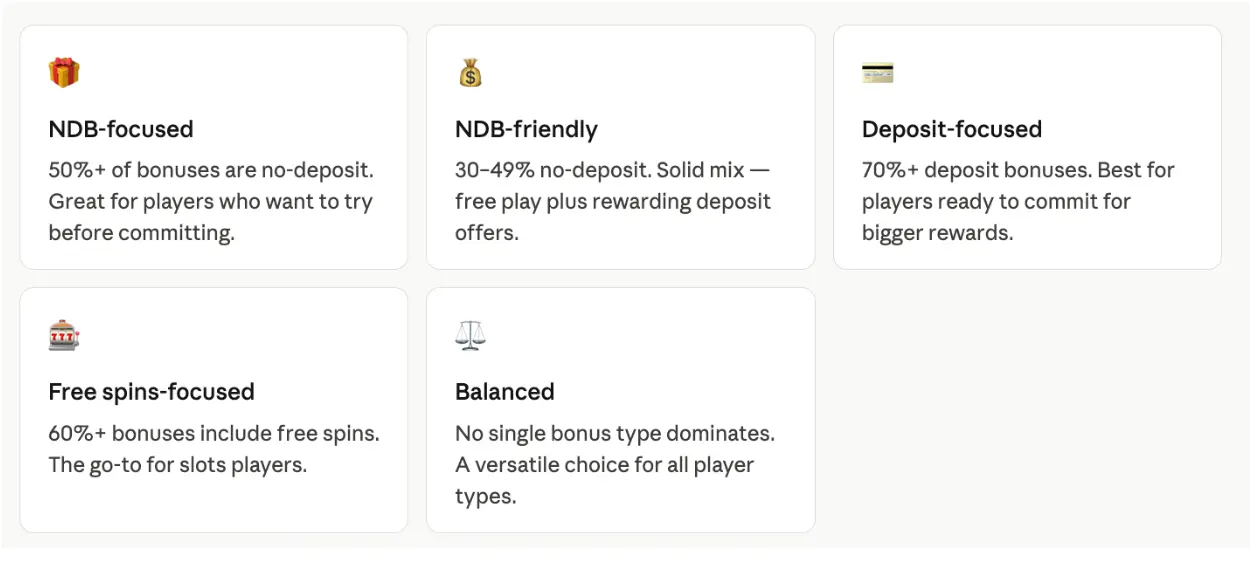
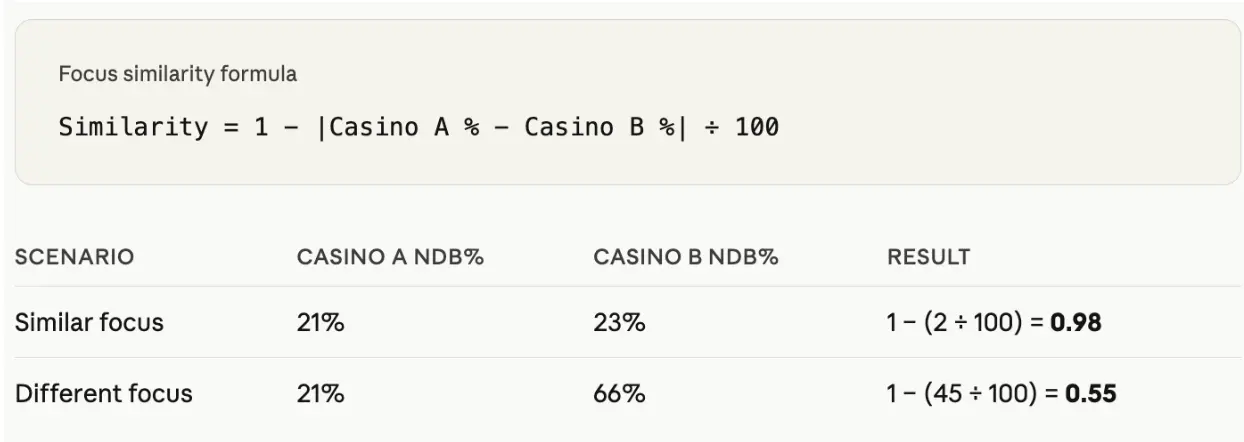
When we match casinos, we compare not just how many bonuses each one has — but whether their bonus programmes are built around the same priorities. A balanced casino and an NDB-focused casino may look similar on paper but deliver a very different player experience.
How the maths works
We use two different formulas depending on whether a criterion involves a list of items (like licences or payment methods) or a number (like bonus count or rating).
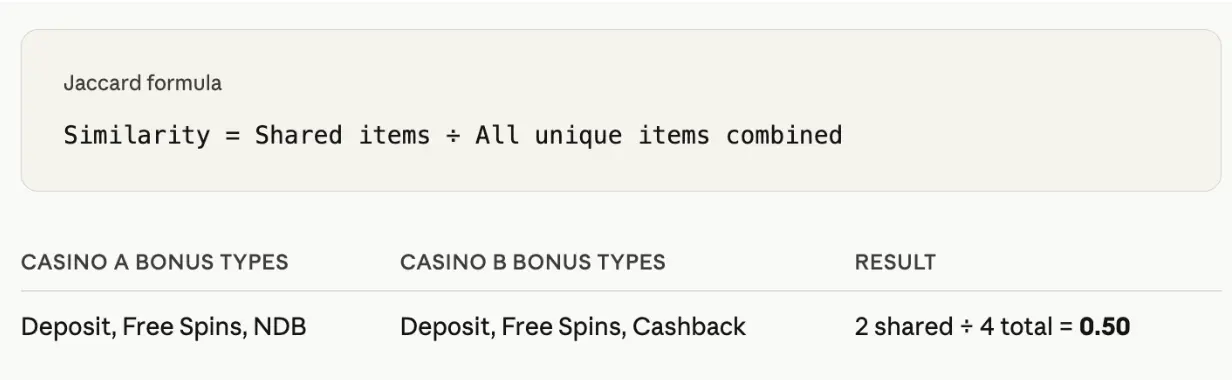
For lists: Jaccard similarity
Used for licences, payment methods, game providers, bonus types, and currencies. It measures how much two sets overlap.
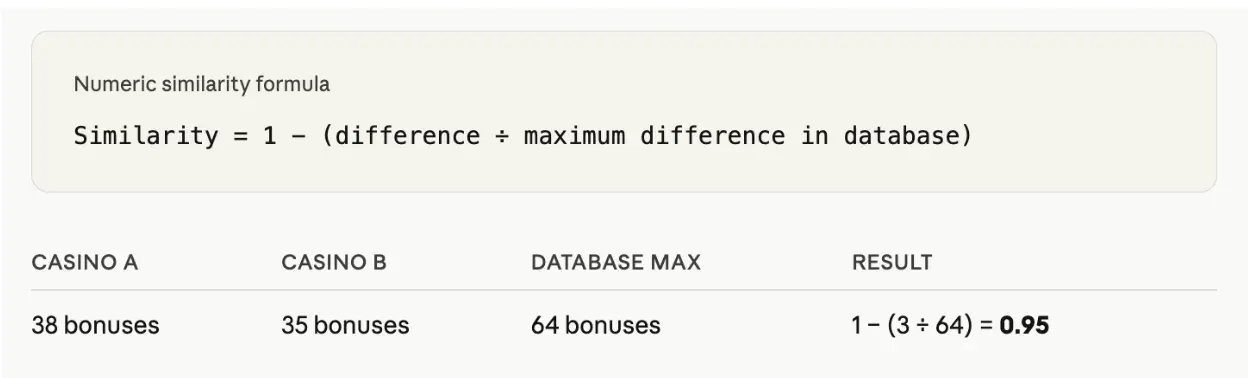
For numbers: proportional distance
Used for bonus counts, quality scores, and ratings. We calculate how different two values are relative to the widest spread seen across our entire database.
For bonus focus: percentage distance
Used for NDB percentage, deposit bonus percentage, and free spins percentage.
A real-world example
Here is how the system compares casinos when looking for alternatives to a balanced casino with 38 bonuses, 8 of which are no-deposit (21% NDB rate).
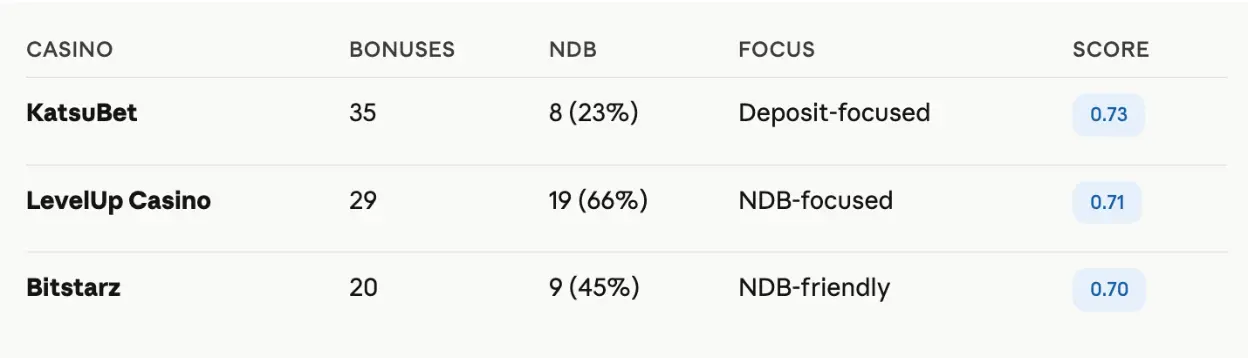
KatsuBet
ranks highest because its bonus count and NDB volume are nearly identical, even though its overall focus differs slightly. LevelUp Casino has far more NDB bonuses in absolute terms — but its entire programme is NDB-focused (66%), making it a different type of casino. That specialisation difference pulls its score down compared to KatsuBet.

Why licences carry the most weight
Licences account for roughly 15% of the total score — more than any other single factor. That is because two casinos operating under the same regulatory body (say, the Malta Gaming Authority and Curaçao) are more likely to share the same standards, player protections, and market access than two casinos that simply offer the same games. Licences are also the hardest thing for a casino to fake or change quickly, making them a reliable signal of genuine similarity.
Payment methods follow closely at ~10% each for deposits and withdrawals. In practice, players who are comfortable with a casino's payment options are most likely to find a similar alternative useful — rather than having to learn a whole new set of deposit flows.

Frequently asked questions
-
Why doesn't the casino with the most no-deposit bonuses always rank first?
-
Because we are matching specialisation, not just volume. If the casino you are looking from has a balanced bonus programme, a heavily NDB-focused alternative will have a lower focus similarity score — even if it has more NDB bonuses in absolute terms. We prioritise relevance over raw numbers.
-
Can I filter results by bonus type?
-
Yes. On any casino page you can filter the "Similar casinos" section by bonus focus — showing only NDB-focused, deposit-focused, or balanced alternatives.
-
What if a casino has missing data?
-
Our system adjusts automatically. If a casino has no game provider data on file, the 5% weight that would have gone to that criterion is redistributed across the remaining factors. Casinos are never penalised unfairly for missing data — but the score may be less precise until more information is available.
-
How often are similarity scores recalculated?
-
Scores recalculate whenever we process new data for either casino in a pair — typically within 24 hours of a bonus being added, a new licence being verified, or a payment method being updated.